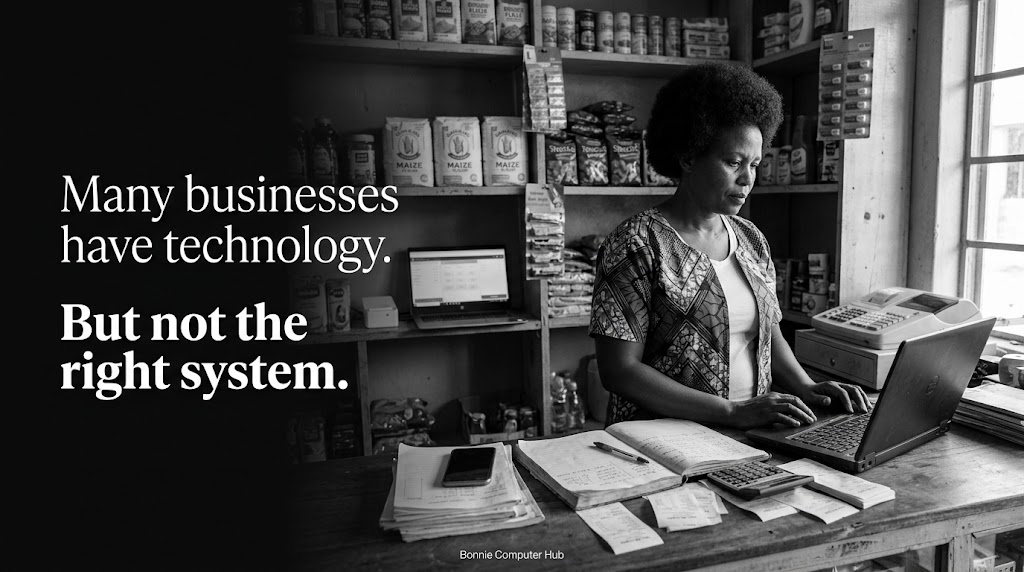
WHY MOST KENYAN BUSINESSES ARE STILL USING THE WRONG SOLUTION
Walk into a hundred businesses in Kenya today.
You will find something that surprises you.
Businesses that are clearly doing well. Busy. Revenue flowing. Staff working. Customers coming in.
Running on systems that are costing them money every single day.
Not because they do not care. Because nobody showed them the gap between what they have and what is possible.
Here is what most Kenyan businesses are actually running on — and what it is costing them.
❌ Solution 1 — The notebook and pen
Still present in more businesses than you would expect.
Sales recorded manually. Stock counted by memory or end of day manual count. No reports. No data. No accountability.
What it costs:
❌ Theft goes undetected for months
❌ Stock runs out before the owner notices
❌ No data to make pricing or stocking decisions
❌ Hours spent on manual reconciliation every month
❌ Solution 2 — Microsoft Excel
The most common "system" in small and medium Kenyan businesses.
An Excel sheet for sales. Another for stock. Another for expenses. Updated manually. Usually by one person who knows where everything is.
What it costs:
❌ One formula error corrupts months of data
❌ No real time updates — information is always behind
❌ The person who manages it leaves and takes the knowledge with them
❌ No access control — anyone can edit or delete anything
❌ Produces no automatic reports or alerts
❌ Solution 3 — A basic billing software with no inventory
Some businesses upgraded to software that generates invoices and receipts. But nothing more.
What it costs:
❌ Stock is still managed separately — usually on paper or Excel
❌ No connection between what was sold and what remains
❌ Reports are partial — sales yes, stock no
❌ Business owner still cannot see the full picture
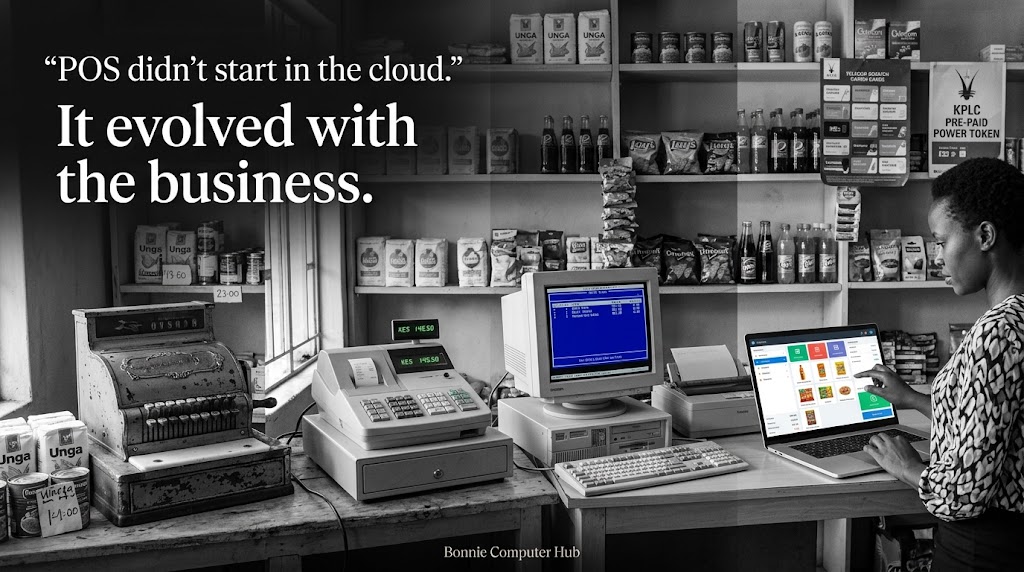
❌ Solution 4 — An outdated POS from ten years ago
Some businesses invested in a POS years ago. But never upgraded. The software is old. The vendor no longer supports it. It does not integrate with M-Pesa. It has no cloud access. It breaks and nobody knows how to fix it.
What it costs:
❌ No M-Pesa integration — cashiers manage M-Pesa separately and manually
❌ No remote access — owner must be physically present to know what is happening
❌ Security vulnerabilities from outdated software
❌ No KRA eTIMS compliance — a legal risk in 2026
❌ Solution 5 — A POS built cheaply and abandoned
Some businesses paid a developer for a custom POS. The developer built something quickly, took the money, and disappeared. The system has bugs. Features are missing. Nobody maintains it.
What it costs:
❌ Unreliable system that staff work around rather than through
❌ No support when things break
❌ Business stuck with a half-built tool they cannot improve or replace easily
Why this keeps happening
1️⃣ Awareness — Many business owners do not know what a proper POS can do
2️⃣ Cost perception — They assume a good system is unaffordable
3️⃣ Trust — Bad experiences with developers have made them cautious
4️⃣ Urgency — The current system works well enough to not force a change
5️⃣ Knowledge gap — They do not know the right questions to ask
What this series is doing about it
Over the next 40 articles we are going to close every one of those gaps.
For business owners — you will know exactly what to look for, what to ask, and what to expect.
For developers — you will know how to build it properly, price it fairly, and support it professionally.
The wrong solution is not permanent. But staying on it is a choice.
Is your business running on the right solution — or on the most familiar one?
🌐 www.bonniecomputerhub.co.ke
📲 +254 729 820 689
© Bonnie Computer Hub | Empowering Through Technology